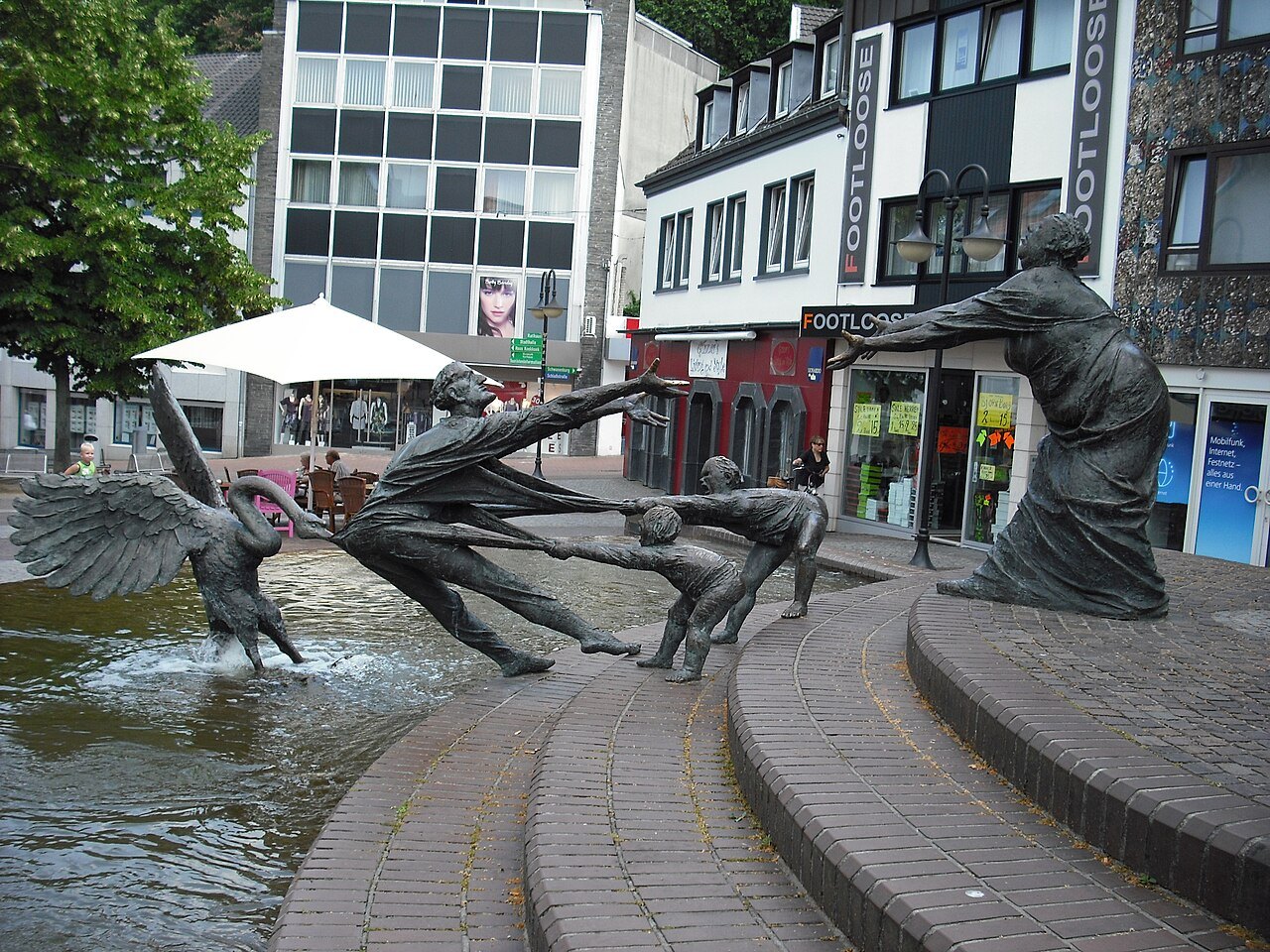

The Elsa fountain at the Fischmarkt offers a way to encounter Kleve's swan story in a form different from the castle. Officially, the work is known as the Lohengrin fountain. Both names may appear in descriptions of the same place. During a visit, rapidly retelling the entire legend matters less than first noticing how motionless figures can suggest an unfolding action.
Look at the scene first
Walk around the fountain where the public space allows. Which figure seems to turn towards another, and what movement is implied by the boat or swan? Look for directions of gaze and distances between figures. A story in bronze has to select a moment, whereas a spoken account can describe many events in sequence.
Then read the official explanation. It names Karl-Henning Seemann as the artist and connects the scene with the forbidden question about the Swan Knight's origins. After that question, the knight leaves the woman in a boat with the swan. Knowing the plot can clarify gestures without replacing your own observation.
Distinguish legend from town history
The Swan Knight legend belongs to Kleve's cultural identity. It is not, however, a dependable chronicle of a documented event. Different names and versions are also no reason to construct a definite historical biography at the fountain. With children, explain that a town can repeatedly tell and depict a story without every part of it having happened.
One useful activity is to describe a possible action from the figures first, then compare it with the explanation. Several observations can make sense. Avoid turning the visit into a guessing game with only one tiny detail counted as the right answer. The interesting question is how an artist makes relationships and departure visible.
Art among everyday activity
The fountain stands in the town centre and also serves as a reference point. Pause without obstructing passers-by or nearby activities. For a photograph, wait for a quiet gap rather than trying to push other people out of the scene. Running water changes the atmosphere, but it does not determine whether the sculptural group can be appreciated.
If you later see Schwanenburg, compare two uses of the swan motif: here it participates in a narrative, while there it acts as a sign for a building and the town. You do not need a long themed itinerary to make that connection. This small comparison already turns a fountain stop into more than an interchangeable photo opportunity.