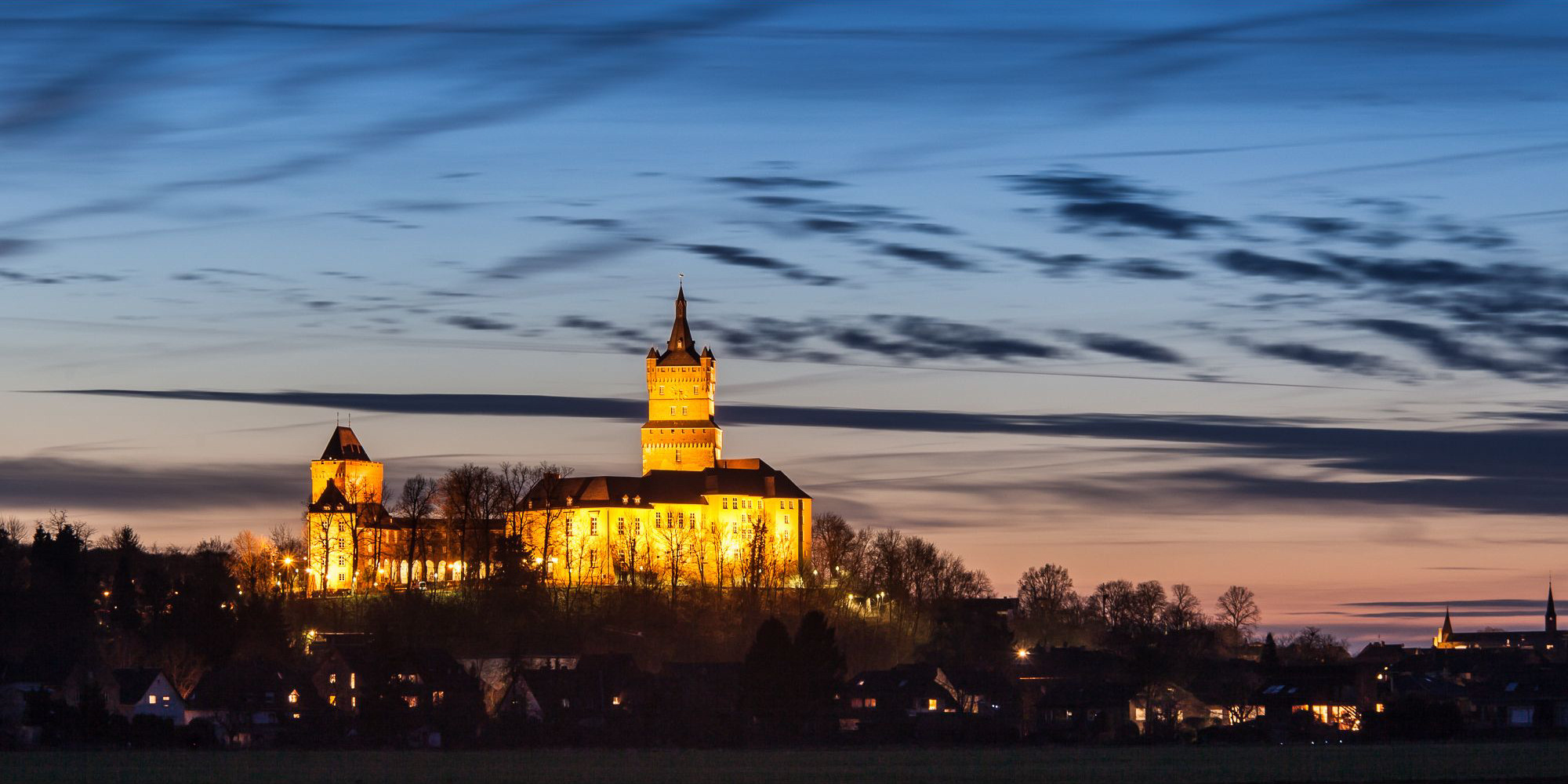

Schwanenburg is an easy landmark to pick out above Kleve. Yet a visit need not revolve entirely around reaching the top of its tower. On Schlossberg, architectural history, views and present-day working life sit close together: the castle houses Kleve's courts. Expecting a palace museum with unrestricted access to every room would mean planning for a different kind of place.
Choose the visit before filling the day
Decide what matters most before travelling. To see the outline of the castle and its relationship with the town, use the accessible paths outside the buildings. For an indoor visit, check the information for the Schwanenturm. Rooms in the Spiegelturm can feature in advertised guided tours; an open courtyard does not mean every doorway is a visitor entrance.
Consult the official museum page for visiting arrangements. Read its notices about restrictions as well as any opening times, rather than relying on a search-result preview. For a guided visit, establish which rooms are included in that particular offer. Avoid placing your next appointment immediately after the intended tower visit. Stairs, questions and an extra look through a window rarely fit neatly into a minute-by-minute schedule.
Two towers and reused fragments
The Klevischer Verein describes the Schwanenturm as built from tuff stone and the Spiegelturm as a brick tower with a red coating. That distinction gives you something concrete to look for. Identify the main building forms first, then turn to individual doorways and carved stones. What initially appears to be one uniform castle becomes a group of structures with different layers.
The former knights' hall leaves a particular clue. Built around 1170, it collapsed in 1771; decorated fragments were subsequently incorporated into courtyard portals. The tourism account also tells the legend of the Swan Knight. When visiting with children, present it as a legend and keep it separate from the dated building remains. The swan on the tower is a visible motif, and the story helps explain its cultural importance, without proving the history of the construction.
The view comes with a climb
From the Schwanenturm, the view stretches across the Rhine plain towards the Netherlands. How much you can identify depends on visibility. If photography is your main interest, think about whether you want the castle in your picture or the panorama from it. On a hazy day, nearby architectural details may offer more than an indistinct horizon.
Access is not step-free throughout. The tourism information identifies slopes, rough paving, stairs and narrow passages. If mobility is a concern, ask about the specific part you intend to visit instead of assuming that the word “castle” implies a particular level of accessibility. A walk outside with a pushchair should also be planned separately from a tower ascent.
Before leaving, look back from a little distance. Which elements were visible below, and which only became apparent in the courtyard? One carefully observed discovery can be more satisfying than adding another rushed stop. Remember that this is part of a working town: keep entrances clear and respect notices marking official areas, even when a door happens to stand open.