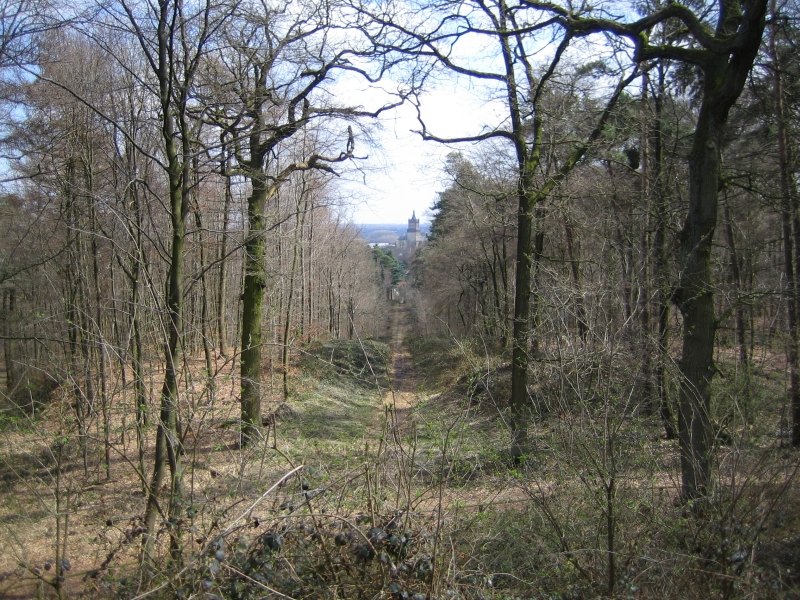

At Sternberg, the most useful question is not how high you stand above the surroundings. It is where your attention is directed. The place belongs to Kleve's historic garden landscape and can be understood as a junction of visual connections. A walk here becomes more revealing when you expect to investigate paths, woodland and distant reference points rather than simply collect a panorama.
A star is made of directions
Niederrhein Tourismus describes Sternberg as a central point from which twelve avenues originally led towards particular viewpoints. That historical arrangement is not a promise of twelve completely open distant views today. Trees grow, routes change and parts of a garden may be restored. The design and its current condition need to be considered separately.
Look for a recognisable straight line on the ground and follow it with your eyes first. Which features support it and which interrupt it? A path may indicate a direction while vegetation limits the view. That remains a readable trace of the system, rather than a reason to dismiss the place as having “no view”.
Woodland frames the landscape
An open line feels different when you reach it from an enclosed stretch of forest. Notice that transition as you approach. The outlook is shaped not only by its destination but also by the movement from confined to open space. Taking a photograph immediately and moving on can miss the part of the experience that unfolds through walking.
For a small sequence of pictures, use three stages: the woodland beforehand, the opening direction and the view from your chosen position. Stay on the paths. You do not need to walk into a vista to understand it, and an apparent shortcut may lead away from the intended circuit.
Include the ascent in route planning
The regional Tiergartenwald walking description includes Sternberg within a larger itinerary. Check which version you are following instead of joining isolated path names at will. Routes towards a similar destination can differ considerably in steepness and surface. With a pushchair or limited mobility, specific information about the path is more useful than assuming that all Lower Rhine woodland is flat.
The return may show the same line in the opposite direction. Consider whether it still visibly relates to the place where you stood earlier. This comparison makes Sternberg understandable as part of a designed landscape. What matters is which directions can actually be recognised from each position.