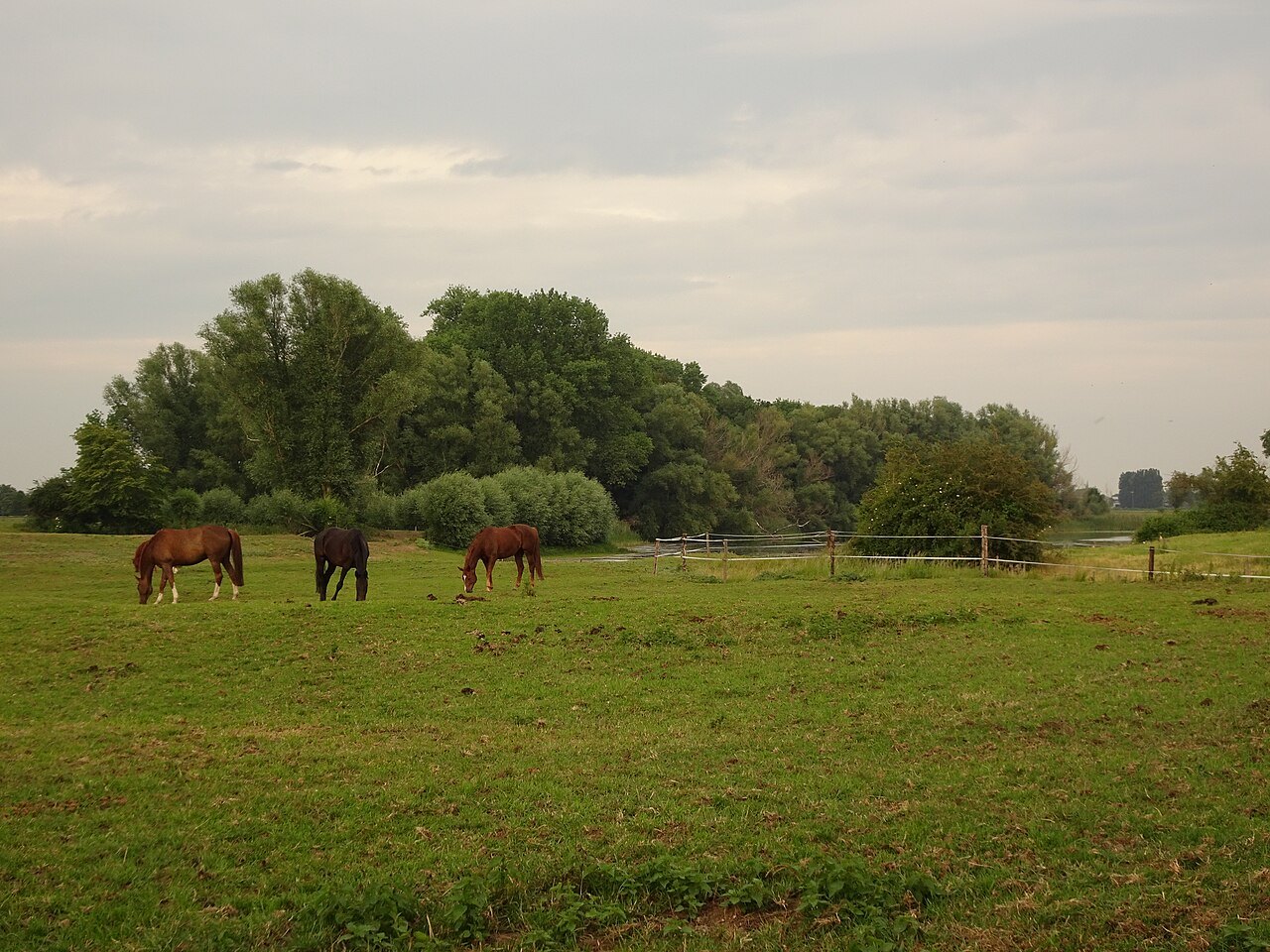

The pools near Rindern, called Rindernsche Kolke by their managing NABU station, lie northwest of Kleve. They are not ornamental park ponds. These small, sometimes rounded waters formed through historic dyke breaches and now sit within a landscape of pastures, hedges and pollarded trees. The historic Drususdeich offers views without requiring access to the banks themselves.
Consider a pool together with its surroundings
At the first stop, you may notice only a reflective surface. Look more closely: is its edge open or densely vegetated? Are the transitions shallow, or does the water appear sharply bounded? Do trees stand immediately alongside it? These differences help explain why neighbouring pools need not offer identical conditions.
The nature station describes both seasonally drying pools and waters that remain throughout the year. A dry hollow is therefore not automatically a ruined pond. Conversely, this natural variation does not mean that every additional drying event is harmless. Long-term changes in water conditions require observations over time. One visit provides a snapshot rather than a complete assessment.
A small comparison exercise
Choose two pools visible from the path and compare the same features at each: the extent of visible water, vegetation at the edge and available shade. Move between positions only on permitted routes. A simple drawing may preserve the differences better than two heavily enlarged photographs without spatial context.
With children, start by suggesting places where an animal might hide. Then check only which potential hiding places can actually be seen. The exercise is not about drawing anything out of cover. Throwing stones into the water or moving plants aside would alter the very situation being observed.
Grazing animals belong in the picture
Grazing is part of the use and management of this landscape. Fences do more than separate visitors from animals; they divide the working land. Stay outside enclosed areas, follow instructions when using any authorised gates, and do not feed livestock. A seemingly curious cow does not turn a pasture into an animal-contact enclosure.
On the return, look once more at the connections between the pools. Hedges, ditches and meadows are not merely empty space between isolated dots of water. Record which structures appear connected from your viewpoint. A short walk then becomes an examination of the wider landscape without needing to reach every pool. It also gives you something concrete to revisit: compare the same edge or line of trees next time rather than expecting identical wildlife at an identical moment.