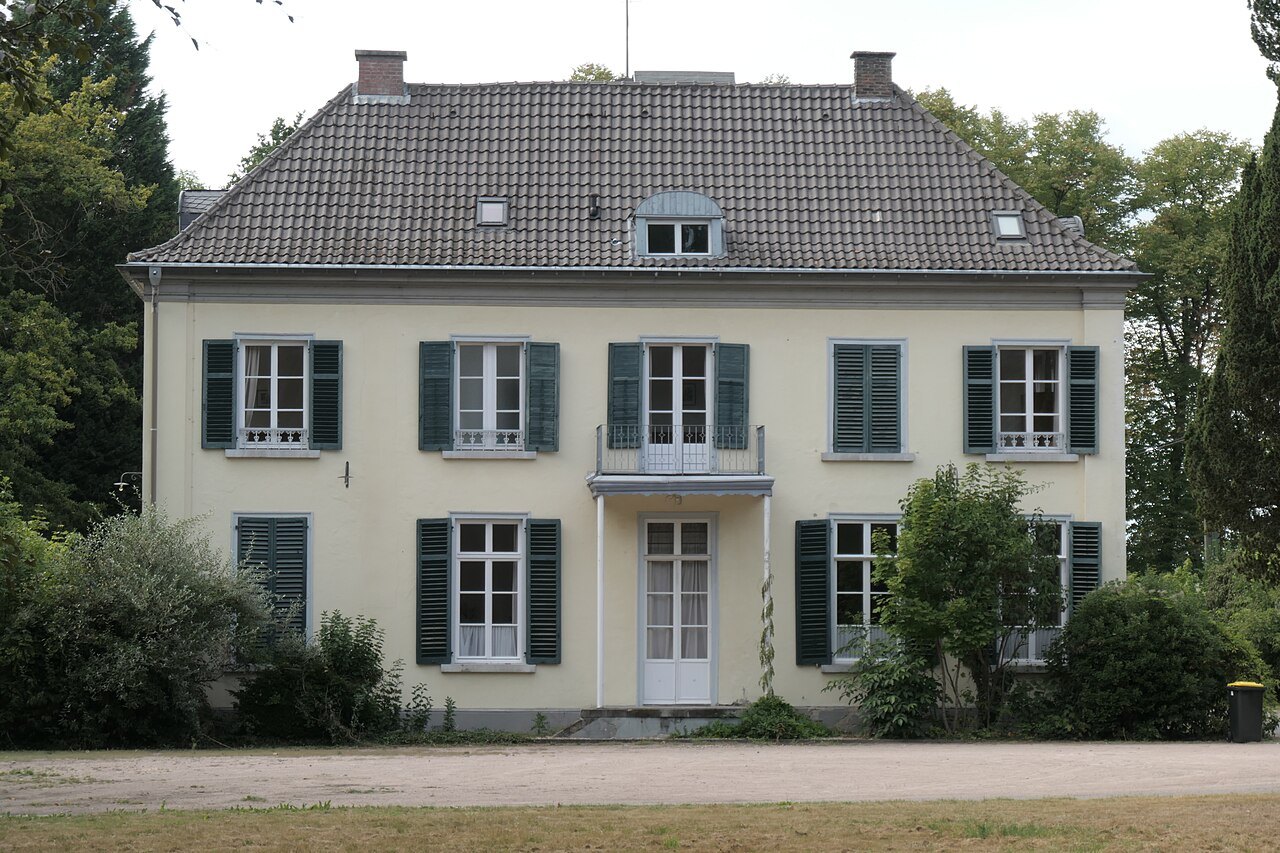

Schloss Gnadenthal appears in several regional excursion routes. That does not mean every building and garden area can be visited without an arrangement. For a walk, a more dependable approach is to view the estate from publicly accessible paths in its setting, treating any indoor visit as a separate offer to check. The outing then remains worthwhile even when no guided visit is available.
Its position is part of its history
The town's garden-conservation study describes Gnadenthal as a Neoclassical complex with a garden combining French and landscape styles. It also places the estate within the wider historic setting of the Neuer Tiergarten. This invites you to look beyond a façade towards approaches, lines of trees and the relationship between buildings and open ground.
Choose a position from which the ensemble can be understood, then vary your distance. Close up, materials and windows draw attention; farther away, the relationship with planting becomes clearer. Where access ends, your exploration should end too. An estate named as a destination is not automatically a public park that can be crossed freely.
Interpret route references carefully
Niederrhein Tourismus includes Gnadenthal in a Joseph Beuys route and identifies an approach from Tiergartenstraße. A cycle itinerary is not a complete description of a walking route, however. For a stroll, check actual footways, crossing points and the return. Do not transfer directions or distances from a cycling tour without considering how they work on foot.
“Schloss Gnadenthal” also appears as a direction in a Tiergartenwald walk. A sign can point towards a place without the described woodland circuit continuing all the way to its entrance. Keep destination, waymark and selected itinerary distinct. This avoids turning a short woodland outing into a much longer walk by accident.
Give an exterior visit substance
Three questions provide a small observation exercise: what looks symmetrical, where do trees direct the view, and which side suggests an entrance rather than a boundary? None requires access indoors or assumptions about private uses. Take photographs from permitted positions and respect anyone working or living there.
If garden design is your main interest, combine the exterior view with one clearly chosen section of Kleve's gardens. If the estate itself is your priority, check for an explicitly offered visiting format beforehand. These are two different kinds of day out with different requirements. Making that distinction allows the historic place to be understood rather than reduced to an attraction whose door happens to be closed.