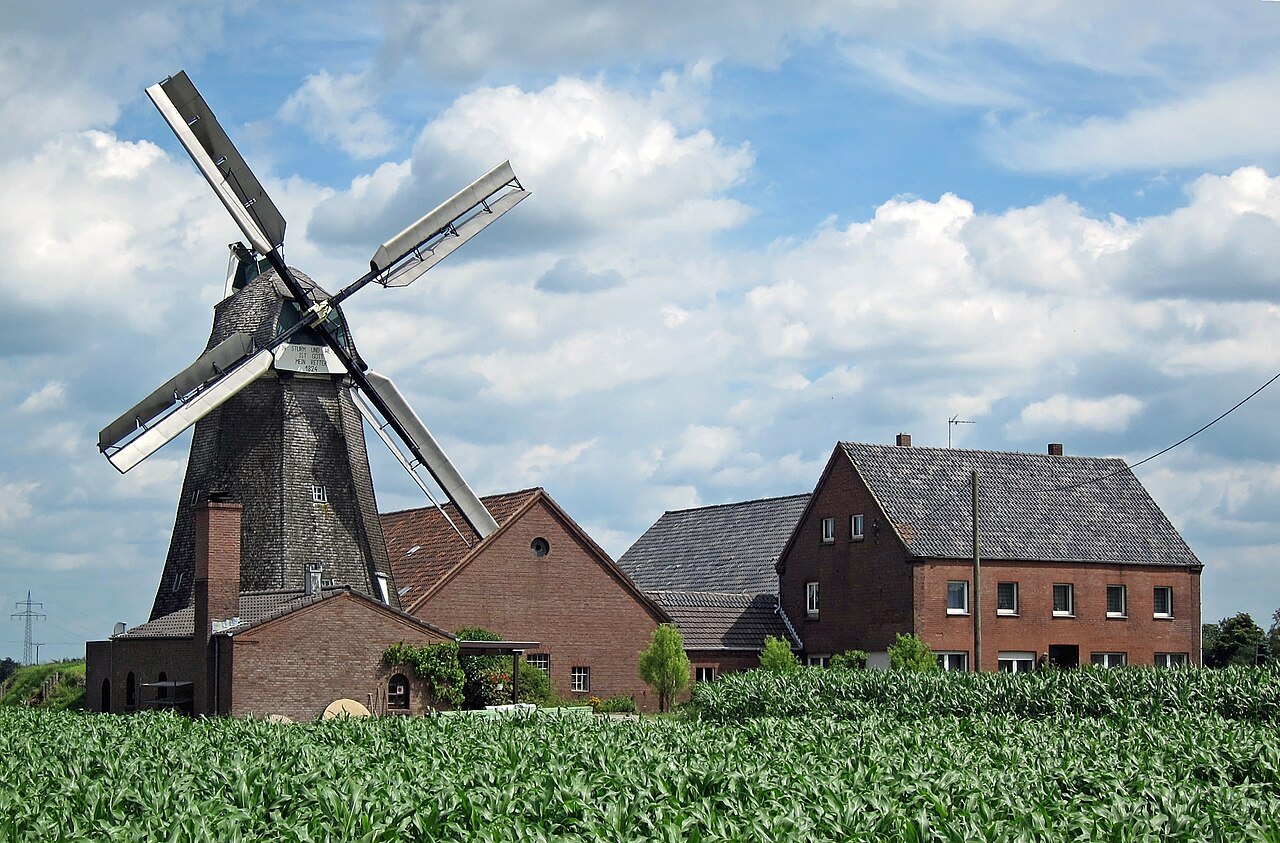
The Alte Mühle in Donsbrüggen is a place where form and function can be explored together. Even from outside, a specific question arises: how does the movement of the sails reach the place where grain is ground? Arriving with that question reveals more than a typical regional photo subject. Current offers from the mill operator determine indoor access; turning sails cannot be guaranteed on every visit.
The engineering begins outside
The regional mill association classifies it as an octagonal Wallholländer with a fantail. First distinguish the tower body from its upper cap. In this type of mill, the cap carrying the sails turns towards the wind. The fantail forms part of the system assisting that alignment. A fixed building and a moving upper section therefore perform different jobs.
You can recognise this distinction without going inside. From the permitted area, notice changes in construction and materials. Keep clear of the sails' operating space and follow staff instructions. A historic technical monument can also be a working machine.
Follow energy through the structure
During an offered visit, try to trace the transmission of power mentally. Ask which components pass movement onwards and where the grain is actually processed. This is more useful than naming each wheel in isolation. A simple sketch with arrows can record what you understand and reveal where a question remains.
Operator and tourism information also address the journey from grain to bread. Milling and baking are separate stages. A flour product cannot be explained by the windmill alone: the grain used and subsequent processing matter too. If you want a demonstration or baking activity, establish that in advance rather than assuming it accompanies every opening.
Preservation belongs to the history
The mill dates from 1824. Kleve's tourism account describes its later closure and the restoration efforts of the support association founded in 1982. Its present appearance therefore tells a story of conservation as well. Treating it as a relic that has operated unchanged since construction would be misleading.
The tourism page notes that the mill is not barrier-free. Ask which parts are actually reachable if access matters to you, and consider an exterior visit as a valid option. Finish by looking at the cap again. After learning how the mill works, its shape becomes an answer to an engineering problem rather than merely a distinctive roof.