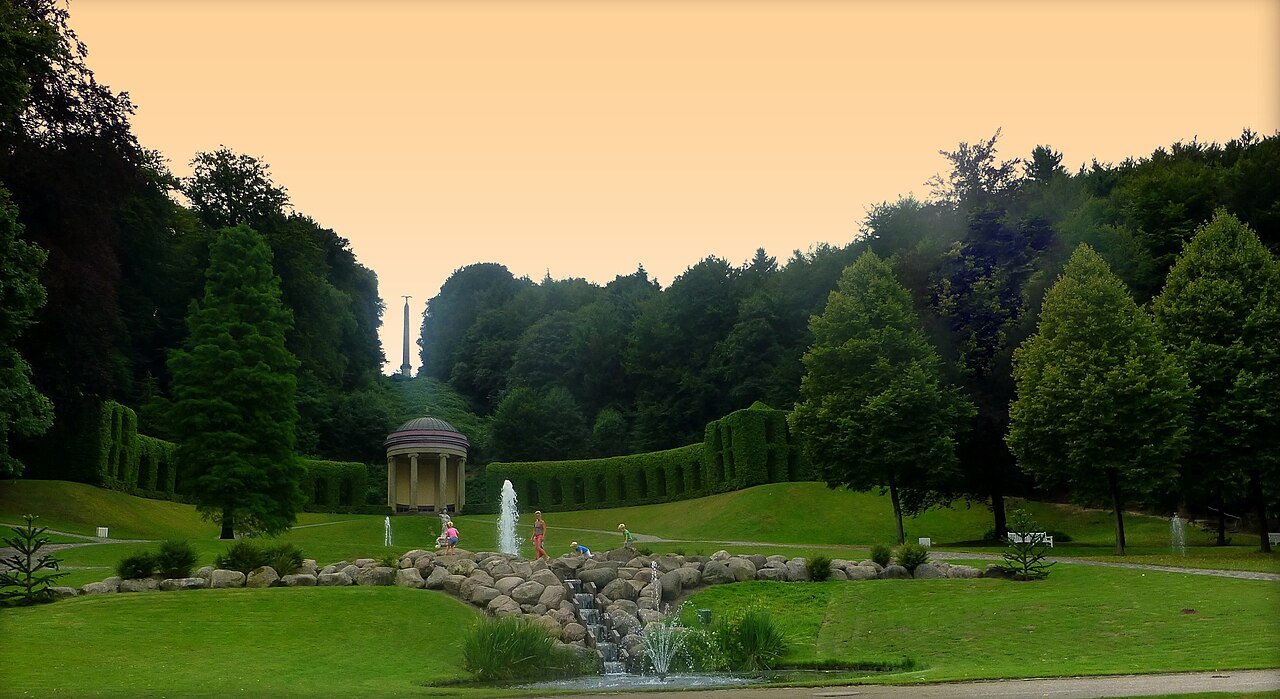

The name “amphitheatre” can create the wrong expectation on a first visit to Kleve. Here it means a garden on Springenberg whose rising terraces recall the shape of a theatre. It belongs to the history of Baroque landscape design, not to an excavated Roman arena. Understanding that distinction lets you look at the place on its own terms: as an arrangement of levels, water surfaces and directions of view.
Look upwards before climbing
The regional tourism account describes terraces with pools and fountains, with a statue of Pallas Athena in the centre. Begin by looking at the sequence from the lower area. From here, the separate levels read together more clearly than if you immediately head uphill. Notice which edges remain visible and where a pool disappears behind the level in front of it.
Water also changes the scene rather than simply occupying it. A still surface can reflect the sky; movement breaks that reflection apart. Whether a particular fountain happens to be running should not decide the value of the visit. The spatial arrangement remains understandable even when not every water feature is operating.
Remember to turn around
After looking towards the terraces, face the opposite direction. The connection with the wider landscape is part of the garden's idea. Official visitor information links the grounds with the Prinz-Moritz Canal and further viewpoints. You do not need to reach all of them to understand the effect of a line directed into the distance.
For photographs, try two distinct tasks: first emphasise symmetry, then choose a side view that makes the changes in level apparent. Stay on accessible paths while doing so. A central picture explains the order, whereas an oblique one may explain the construction of the scene. If visiting with others, compare why the same garden can look almost like two different places in the resulting images.
Give a short visit a clear boundary
A map can tempt you to treat the amphitheatre, higher viewpoints and the Forstgarten as a single stop. Decide on the ground whether a climb suits your group. Steps, gradients and surfaces matter more than a short straight-line distance. In uncertain weather, spending time in the lower area may be the better choice.
Before leaving, look at the statue again from another distance. Close up, an individual figure commands attention; farther away, it becomes part of the whole composition. That shift between detail and landscape is the main reward of a visit. A fixed duration is less useful than allowing yourself time to stop properly at two or three places and see how the arrangement changes.