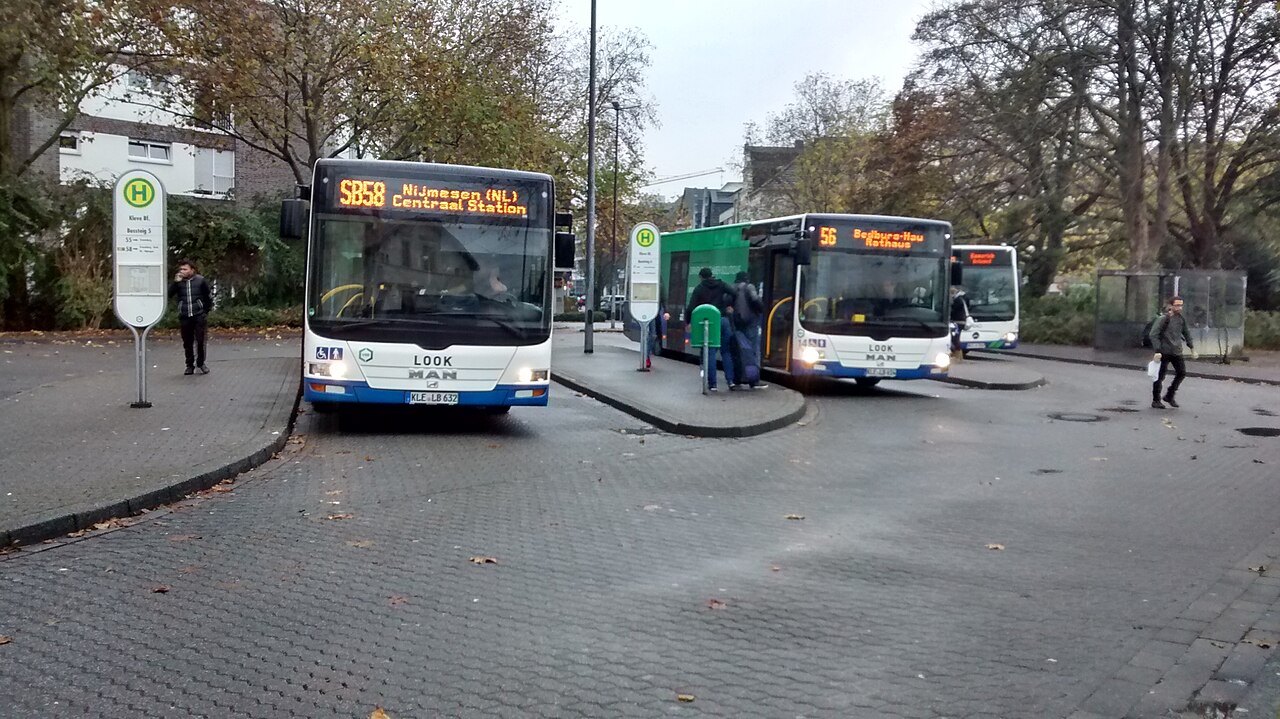

A bus can make the final part of a Lower Rhine outing easier, but planning involves more than finding a line number. The same line may have different directions or variants, and individual journeys do not run every day. NIAG provides journey planning, departures and service notices. Use these for your actual date and the entrance you intend to reach.
Identify the stop precisely
Where possible, enter the destination's full address and inspect the suggested stop on a map. A similarly named district is not necessarily the closest approach. Examine the remaining walk: does it use suitable paths, require crossing a road and end at the visitor entrance?
You also need the correct direction for boarding. Stops on opposite sides of a road may share a name. Note the destination expected on the vehicle display and check the information at the stop. If the details do not agree, ask before boarding rather than recognising the uncertainty several stops later.
Read operating days and notes
Footnotes are part of a posted timetable. A departure may apply only on certain days or during school periods. Do not transfer a weekday assumption to a Sunday. A digital search for a specific date helps, but current service notices still matter.
Read diversion and stop-closure information. A bus may be operating while your intended boarding point is temporarily unavailable. Its replacement may not be immediately beside it. Check the replacement location and approach before leaving home. A screenshot of the original stop does not solve that problem.
A visit with two return options
First find a return service reachable after a realistic visit finish. Add the walk to the stop and a modest margin. Then check whether a later service exists and what it means for subsequent interchanges. A backup is useful only if it actually works.
Consider an example without fixed local timings: you want a break after a museum visit. If the next return is substantially later, decide before the break whether that additional waiting suits the group. Place the final part of the visit nearer the return route rather than watching the departure time from the far end of a large site.
With several people, one person can check the connection, but essential information should not exist on only one phone. Share the stop name, direction and meeting point. If the group separates briefly, agree somewhere to reunite before heading for the bus.
If the return stop is on the opposite side of the road, inspect the appropriate crossing on the outward journey. Remember not only a stop sign but the suitable route from the destination back to it. Several bays may stand close together at a larger interchange. Note the exact designation where provided and check the vehicle destination again. A nearby departure may serve the wrong direction. This brief preparation avoids a rushed search at the end when people are tired or the next bus is already expected. It also makes a meeting point easier to describe.
Replan when circumstances change
A delay or missed connection may change the whole framework of the day. Check the complete revised journey rather than only the next departure. A later bus may arrive after the destination closes. Shorten or replace the visit if the remaining time no longer works. Travel then remains a means of reaching an outing rather than an obligation to continue an obsolete plan.