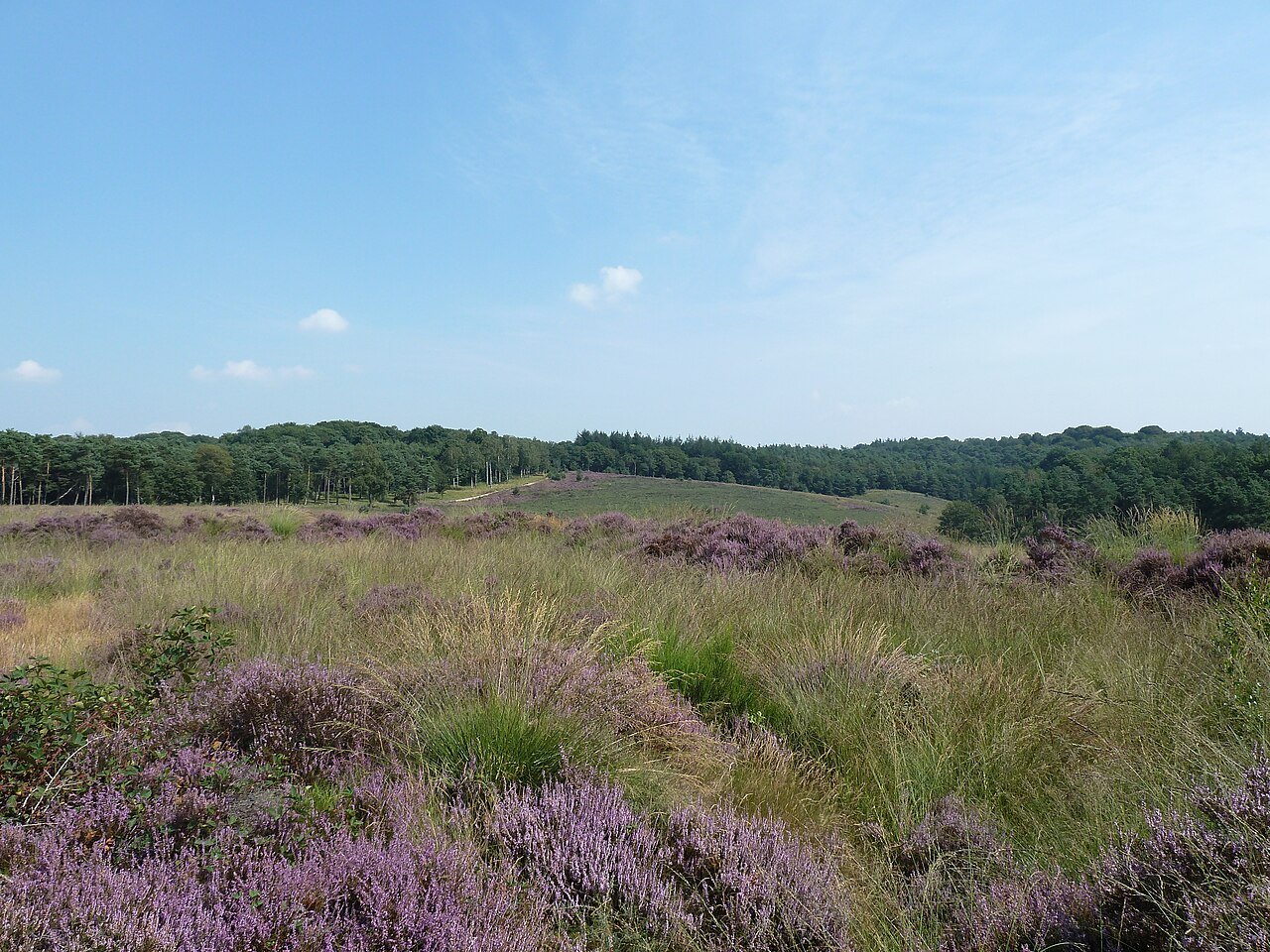
Heumense Schans is one of the historical earthworks around Mookerheide. Natuurmonumenten describes it as a seventeenth-century defensive work and links it with Mookerschans in walking information. Keep the two names distinct when planning. A viewpoint or structure mentioned at one does not automatically exist at the other.
Start history with the position
First examine where the earthwork sits. Which directions are open, and where do trees or slopes restrict the view? A defensive structure can be understood through its location as well as its shape. Present vegetation, however, may create different sightlines from those available during its use.
Avoid concluding that a view blocked today was always blocked. An interpretation panel or official description supplies the historical framework; observation reveals the present condition. They complement each other while remaining distinguishable. This matters especially where low banks survive instead of imposing walls.
Examine the shape from several angles
Follow the intended path and consider the structure from several permitted positions. An edge barely visible head-on may become clearer in oblique light. Photograph the overall setting before a detail. Stay out of sensitive vegetation and do not shortcut across banks.
For children, try drawing a few simple lines. Where does a boundary appear to run? Which ground is higher? Where does the modern path pass? The sketch need not be exact. It helps turn an archaeological feature into a spatial arrangement rather than an inconspicuous mound beside a nameboard.
The second earthwork is an additional choice
The official Two Earthworks route joins several elements of the surrounding area. If time or energy is limited, do not automatically include every stop. Check the present route, distance and elevation changes. One earthwork can provide a complete focus for a visit.
Keep attention available for gradients and changing surfaces on the return. Historical places within heathland are not uniformly surfaced museum galleries. A pause at a suitable location helps organise the observations: what could be recognised in the ground, and what is known only from the description? That question makes a useful conclusion because it requires neither a spectacular view nor a fully surviving fortress. It also gives a later visit a clear task, such as examining an angle that was obscured by seasonal vegetation, without encouraging any attempt to uncover or alter the remains yourself.