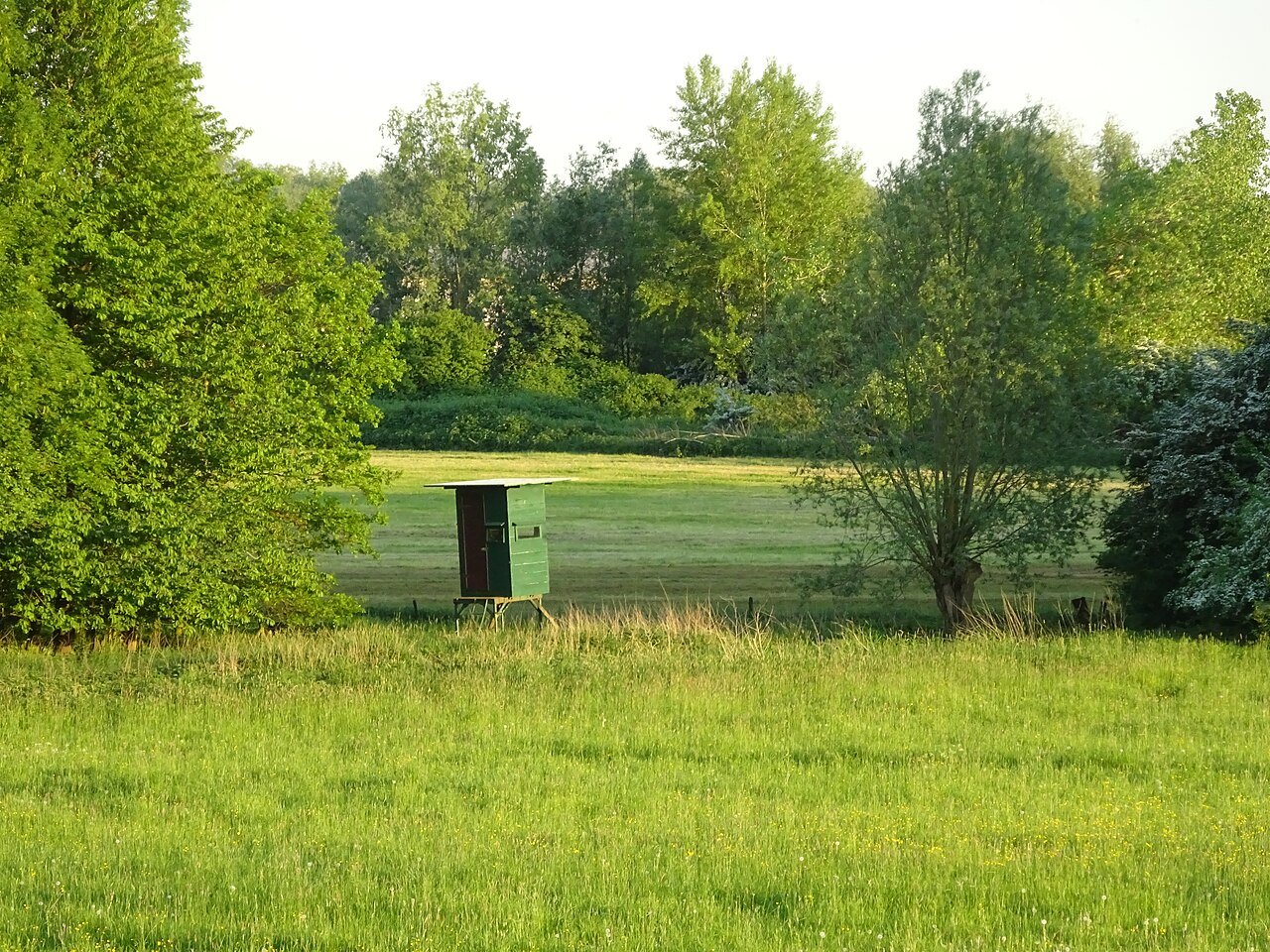

At Emmericher Ward, it is useful to treat the raised path as an observation position. The reserve lies on the right bank of the Rhine, west of Emmerich's suspension bridge. The NABU nature station recommends the walking and cycling path along the main dyke, which provides views along the reserve. Access becomes part of the experience: distance offers an overview that would disappear among the plants themselves.
Three layers in one view
Find a safe place beside the path where others can still pass. Look first at nearby grassland, then at water or depressions, and finally at trees and shrubs. Not every section contains all three. These differences help explain the reserve as a mosaic rather than a uniform expanse.
The Ward includes flood meadows, old channels and floodplain woodland. Water changes more than the visible shoreline here. Different moisture conditions can support different vegetation and offer animals different opportunities. An open sandy patch is therefore not necessarily unused ground. Understanding its position in the wider scene is more useful than searching for a way to reach it.
Avoid explaining every change immediately
A dry ditch during one visit does not demonstrate a long-term trend. Equally, a full hollow does not prove that a water-management problem has been permanently resolved. To follow changes, photograph in the same direction from the same permitted location and record the date and visible conditions. Separating observation from assumption already improves your understanding of the landscape.
For children, this can become a small investigation: find three different ground levels without leaving the path. A dyke, a flat meadow and a depression are enough. Then ask where water might collect first. Treat the answers as ideas to explore, rather than predictions of a particular flood.
Leave the shared path usable
On a walking and cycling route, slow observation meets people travelling at a steady pace. Do not set up binoculars or a camera in the middle of the usable width, and avoid suddenly changing sides. Larger groups can spread their stops along the route instead of forming a barrier across it.
Warm clothing and a sheltered, permitted standing place help during longer observation. If neither is available, shorten the pause. Birds remaining distant is a normal outcome, not a failed visit. Excursions organised by the managing station can explain additional relationships; check their dates and meeting points separately. An independent observation walk on the dyke and an organised excursion follow different arrangements and should not be treated as interchangeable plans.