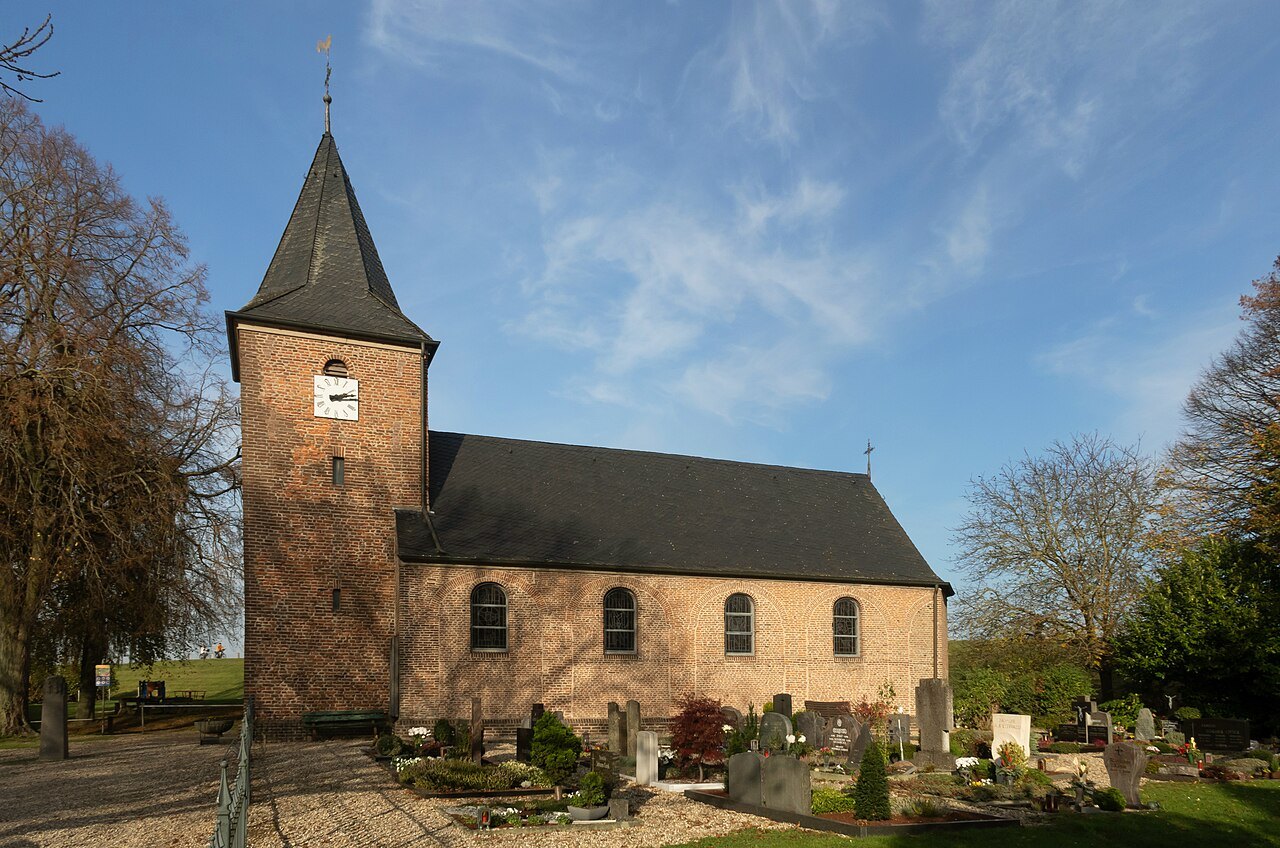

Bimmen lies at the northwestern edge of Kleve, immediately beside the Dutch border. A visit does not have to become a long international excursion. The small village already offers three distinct perspectives: its centre, the Rhine and cooperation across a national boundary. These connections can be understood without entering private land or technical premises.
From village to dyke
The municipal description identifies St. Martinus and its adjoining cemetery as the centre and Heerstraße as a route through the village. Begin at that small settlement scale. How do houses relate to the road, and where does building give way to open ground? The Rhine is more than a backdrop: it also explains why a dyke protects the inhabited area.
On an authorised dyke path, the perspective changes. Village, meadows and river can be seen from a different level. Consider other users, especially cyclists, and stand where people can pass while you look. A dyke is a protective structure and sometimes a transport route; its slopes are not unrestricted play space.
A river is monitored together
According to the Federal Institute of Hydrology, the International Monitoring Station Bimmen-Lobith belongs to the Rhine's monitoring network. Its information contributes, among other purposes, to warnings about unusual concentrations of substances. This gives the border setting a concrete meaning: water does not stop at administrative boundaries, and observing it requires cooperation.
The station is a workplace rather than a museum that is automatically open to visitors. View it from public space where possible and use official explanations to understand its role. The river's colour or calm appearance cannot reliably reveal its chemical quality. That distinction between a visible landscape and measured properties provides an interesting subject for discussion.
Do not make the border an unplanned extension
Millingen is nearby, but continuing there on foot or by bicycle requires a return plan of its own. Check distance, mode of travel and the connection home before extending a short village visit. A neighbouring place name on a map does not automatically create a convenient circuit.
Bring water and suitable clothing for time beside the exposed Rhine. Do not assume that a small village will provide refreshments whenever you arrive. End by looking back towards the church tower: it belongs to local everyday life while an international waterway runs beyond it. That close relationship helps explain Bimmen as a destination.