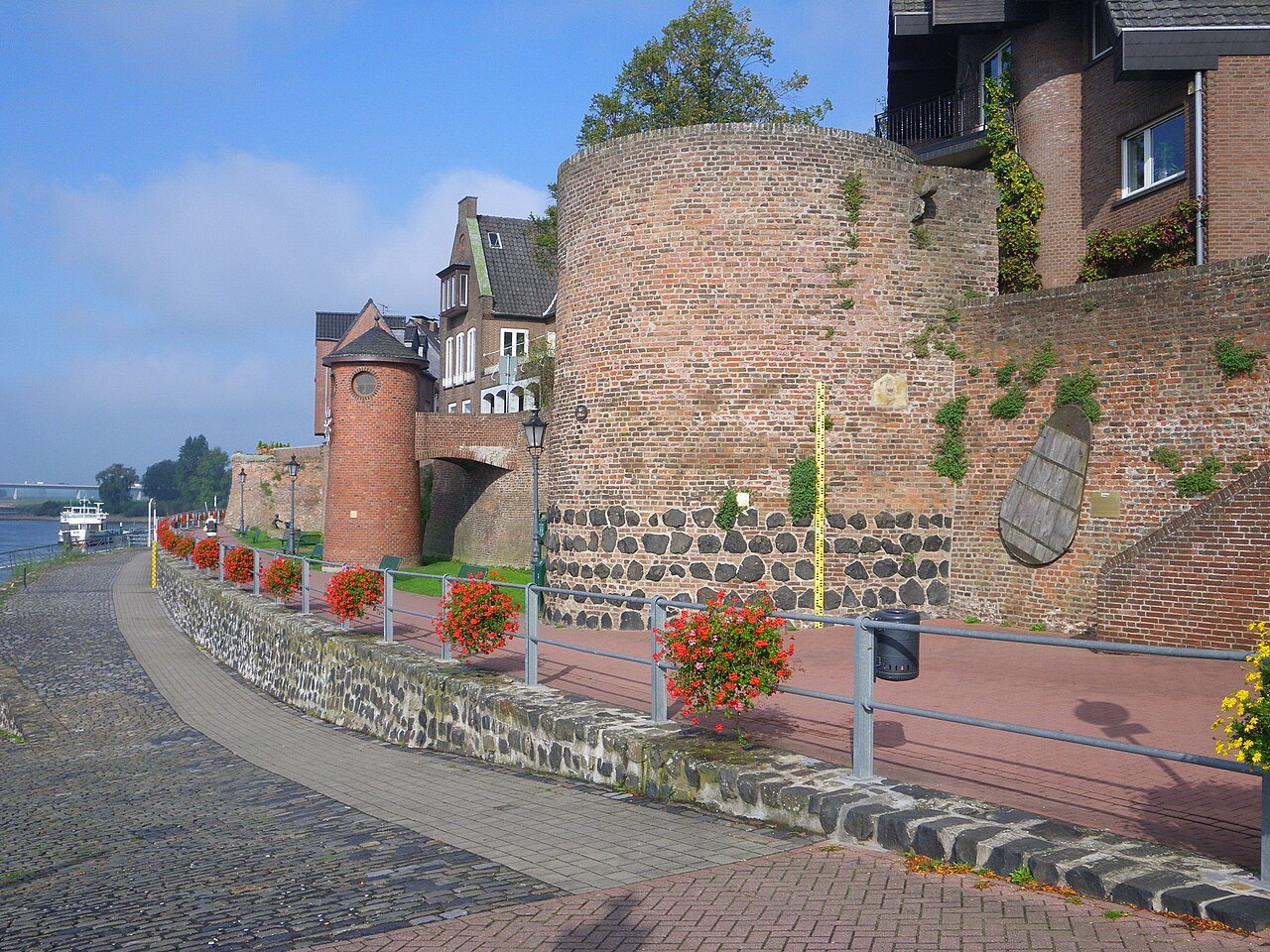

In Rees, the Rhine and the town defences belong to a single story. The wall was intended to resist more than human attackers: the river itself placed demands on the town's protection. A walk becomes easier to understand when you consider the structures by function. Begin at a publicly accessible section of the river frontage and compare individual towers instead of assuming they all belong to one building phase.
Three jobs beside the water
The town identifies 1289 as the start of construction of the stone wall. Work initially concentrated on the particularly exposed river side. The surviving line therefore marks a boundary between town and river landscape that involved both protection and control. Look towards the wall from the waterfront, then outwards from the town side. The same structure reads differently from these positions.
According to the municipal account, the Old Customs Tower, also called Töldersturm, dates from 1299. It monitored Rhine tolls. Its purpose helps explain why a trading route on water generated revenue and political power. The tower is more than an attractive photographic subject; its position is part of its function.
The gauge tower, by contrast, is a modern structure serving navigation and explicitly does not belong to the historic fortifications. This comparison prevents a common misunderstanding: not every tower-shaped building beside the Rhine is medieval. Look for an explanation of each structure's purpose before assigning them a shared origin.
Reading one stretch slowly
A short visit can concentrate on the wall, customs tower and a view across the river. Examine changes in materials, openings and the connection with the present promenade. A repaired section need not be dismissed as a disruption to the setting. It may show that a structure has remained in use and required care over a long period.
The Mühlenturm adds further functions. The town describes it as a mill, defensive structure and protection against pressure from an ice-bound Rhine. Consult current information for visits or access to its upper level. A closed tower does not prevent an exterior walk, but it matters to anyone whose main intention is to climb it.
Returning along the same bank
Initially plan to return on the same side of the Rhine. A ferry or boat trip can be added once operation and schedules are confirmed. No crossing is necessary to understand the relationship between the town and its defences.
With children, try one simple question: which structure measures, which controlled trade, and which protected the town? The answer need not be obvious in every detail. The useful discovery is that a succession of similar silhouettes can represent quite different jobs.